


Colorado lawmakers have rejected a bill that would put a measure on the state’s November ballot asking voters to increase marijuana and alcohol taxes to support mental health treatment.
In line with a recommendation from the bicameral Capital Development Committee (CDC) last week, members of the House Health and Human Services Committee on Wednesday defeated the legislation from Rep. Bob Marshall (D) and Sen. Judy Amabile (D) in a 7-6 vote.
“We have made our penal system the default mental health system for people that are over 18 years old. It has been a travesty,” Marshall said on Wednesday before the panel’s vote to reject his bill. “It’s been a known travesty for years and years and years, and yet nothing happens to fix the issue.
“At the end of the day, this is something that needs to be done,” the sponsor said of the HB 1301, which aims to hike taxes on the substances and put the additional revenue toward the creation of a mental health fund overseen by the state Department of Human Services (DHS). “And if we don’t do it now, the problem is going to get worse and worse and worse.”
If the bill had advanced through legislature, voters across the state would have then decided on increasing the state retail marijuana sales and excise taxes by 0.42 percentage points each at the ballot this coming November. Alcohol taxes by volume would have also increased for the first time in more than 30 years, by varying levels depending on the product type.
“The bill requires the treasurer to transfer an amount equal to the tax revenue raised as a result of the bill to the hospital support account that is created in the capital construction fund,” a summary of the measure said. DHS would be able to expend the funds in “priority order,” starting with the creation of a mental health institute in Aurora, then going toward operational costs for the institute and “long-term civil commitment facilities” in Mesa County.
Under amendments adopted in committee on Wednesday, the proposed tax hike for alcohol would have been slightly reduced, but not for cannabis. The bill title was also revised in response to input from the state attorney general, and a fiscal note was added to flag programmatic costs amounting to $14,000 that the sponsor said would come out of the general fund.
During last week’s CDC meeting, Rep. Tammy Story (D), vice chair of the panel, asked House bill sponsor Marshall how he squares the proposal to hike marijuana taxes with the fact that the state has seen cannabis sales and resulting revenue slump over recent years. Marshall said he appreciated the concerns—but he didn’t intend to remove cannabis from the measure.
“In hindsight, maybe a sales tax might have been better,” Marshall conceded on Wednesday. “But it’s in the title now—‘tax on harmful substances’—and we put marijuana in there at the suggestion of a couple of the sheriffs, just to share the pain, so to speak.”
Marijuana industry representatives have criticized the bill’s marijuana tax provisions, in part by pointing out that the state already imposes significant taxes on cannabis sales compared to other states and commodities. Making it more expensive for consumers to purchase marijuana for licensed retailers could also undermine efforts to eliminate the illicit market, drawing buyers back to unlicensed sources where no tax dollars would be generated for the state.
While the state has seen over $1 billion in marijuana sales in 2025—a milestone the governor touted in December—tax revenue from cannabis sales has gradually decreased over the past five years as more states have enacted legalization and as intoxicating hemp products have grown in popularity. Nonetheless, cannabis is still bringing in more tax dollars compared to alcohol or cigarettes.
Adult-use marijuana is currently taxed at three levels in Colorado: A 15 percent excise tax, 15 percent special sales tax and 2.9 percent state general sales tax. As one of the first states to legalize marijuana for recreational use, Colorado saw revenue from those sales grow “consistently for the first eight years of legalization, peaking at $424.4 million FY 2020-21,” a report from the state that was released last month says.
—
Marijuana Moment is tracking hundreds of cannabis, psychedelics and drug policy bills in state legislatures and Congress this year. Patreon supporters pledging at least $25/month get access to our interactive maps, charts and hearing calendar so they don’t miss any developments.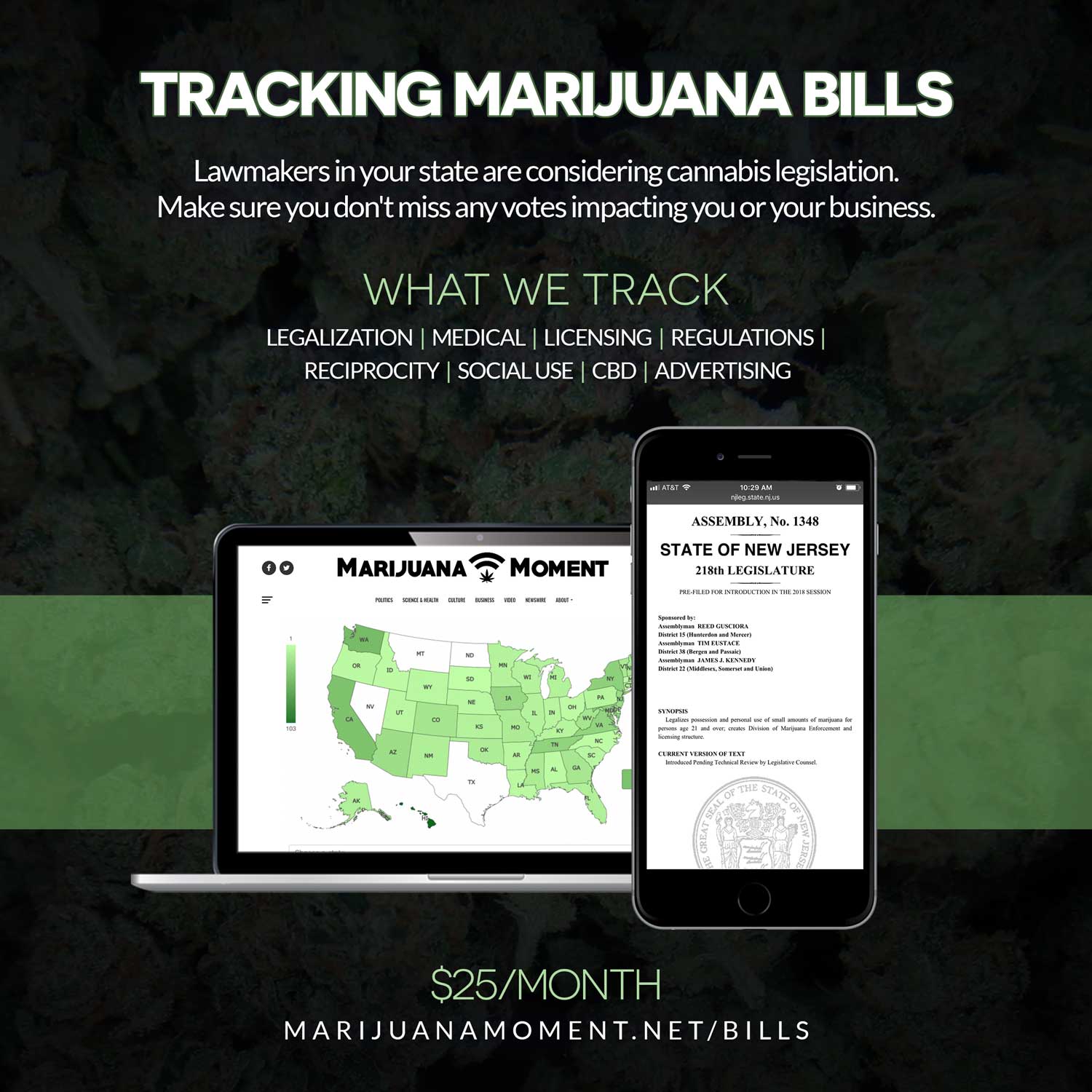
Learn more about our marijuana bill tracker and become a supporter on Patreon to get access.
—
Meanwhile, the Colorado House of Representatives last week sent a bill to the governor that would allow terminally ill patients to use medical marijuana in healthcare facilities such as hospitals. Advocates have been critical about changes made throughout the legislative process—arguing, for example, that making it so hospitals would have the option—rather than a mandate—to allow medical cannabis use in their facilities fundamentally undermines the intent of the reform.
Gov. Jared Polis (D) also said last month that his state should not have joined a lawsuit supporting the federal ban on gun ownership by people who use marijuana that recently went before the U.S. Supreme Court—and he personally opposes the state attorney general’s “legal position on this.”
Photo courtesy of Brian Shamblen.
