


Charcoal joint filters filter out terpenes, which are both tasty and beneficial. They barely reduce the tar. Here’s what nobody’s telling you: take the terpenes out, you get less high. So you smoke more to chase what you lost, and you end up with more tar, not less. Big Tobacco got caught running this same scheme. Watch out for “Light Joints.”
The Short Version
- The chemistry: The charcoal grabs the tasty and beneficial stuff (terps). Terpenes shape both flavor and how high you get. It barely reduces the tar.
- The science nobody mentions: Terpenes aren’t just flavor. They shape how high you actually get. Remove them and the same joint gets you less high.
- The tobacco precedent: “Light” cigarettes tested cleaner in the lab. Actual smokers consistently smoked more to get the same amount of nicotine. So they got more harm, not less. The deceptive marketing got banned in 40+ countries.
- The math: Filter or no filter, you’re chasing the same high. With a filter, you just smoke more weed to get there.
- The three-way loss: More tar in your lungs. More weed gone from your jar. Plus you paid for the filter that did it.
Here’s how charcoal filters actually work. The charcoal grabs the tasty and beneficial compounds coming off your weed: the terpenes that shape the high, the flavor, the smell, everything that makes one strain hit different from another. And here’s the part most people don’t know: terpenes aren’t just flavor. They shape how high you get. The difference between an indica that puts you on the couch and a sativa that fires you up isn’t really about THC content. It’s about terpenes. Take them out and you get less high off the same joint, full stop. You can still get high. Just not as high. The filter doesn’t block the drug. It lowers the ceiling.
Charcoal filters don’t remove every last terpene, of course. But they grab a huge portion of them. Big enough that indoor grow operations commonly run charcoal filters on their exhaust for exactly this reason: to strip the terpenes out of the air and hide the smell, either from the cops or from the neighbors. The same material that scrubs the skunk out of a grow room is the material sitting at the end of your filtered joint.
Quick primer for the people who haven’t been down this rabbit hole. Terpenes are the aromatic oils the cannabis plant produces in the same trichomes that make THC. They’re what gives Sour Diesel its diesel and Blueberry its blueberry. But they do more than smell good. Peer-reviewed research has documented anti-inflammatory effects from myrcene, analgesic effects from beta-caryophyllene and other cannabis terpenes, mood lift from limonene, calming effects from linalool. They also work alongside THC and CBD in what researchers call the entourage effect: the components of the plant amplifying each other. The flavor and the function travel together. Strip one out and you lose the other.
Meanwhile, the filter barely touches the tar, which is the stuff it’s supposedly there to remove in the first place. So you end up with weaker smoke, more tar in your lungs than the marketing implies, and a craving to smoke more weed to chase the high you would have gotten from a plain joint. That’s the whole scam.
Three losses on one purchase. You burn through more weed. You get more tar in your lungs, not less. And you paid for the filter that made you do it.
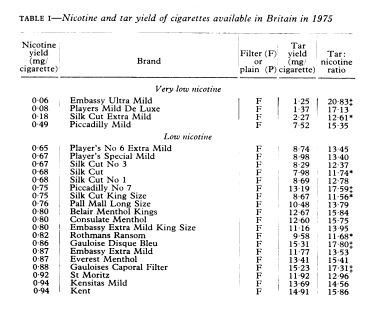
Big Tobacco ran this exact play for fifty years. They put filters on cigarettes and called them “light” and “low-tar.” In a lab, the cigarettes did test cleaner. In the real world, smokers wanted the same amount of nicotine they were used to, so they smoked harder, longer and more often to get it. By the time the research caught up, the “light” cigarette had been linked to a whole new category of lung cancer, and the marketing language was banned in the United States and forty other countries. Cannabis filters are running the same scheme.
What the Tobacco Record Established
Filtered cigarettes entered the U.S. market on a large scale in the 1950s, after a series of medical studies began linking smoking to lung cancer. Manufacturers responded with cellulose acetate filters and, eventually, with “light” and “low-tar” variants designed to lower the machine-measured yields of tar and nicotine. The first major federal review of these products, the U.S. National Cancer Institute’s Monograph 13, published in 2001, looked at four decades of data and came back with a verdict: lower machine yields did not translate into lower exposure for actual human smokers. The “light” cigarette wasn’t lighter on the lungs. It was lighter on paper.
The reason was a phenomenon researchers had begun documenting in the 1970s, in studies by Michael Russell, Ronald Sutton, and others, called compensatory smoking: when the dose of nicotine per cigarette dropped, smokers (without consciously choosing to) adjusted their behavior to restore it. They took larger puffs, more frequent puffs, longer inhalations. They smoked more cigarettes per day. The behavior was universal among addicted smokers. The 2004 Surgeon General’s report, The Health Consequences of Smoking, reviewed the same literature and arrived at the same conclusion.

Internal tobacco-industry documents, released after the 1998 Master Settlement Agreement, proved that Big Tobacco had known about compensation since the 1970s and kept marketing “light” cigarettes as a reduced-harm product anyway. They knew. They lied. They kept selling. In December 2008, the U.S. Federal Trade Commission formally rescinded its decades-old machine-yield tar measurement (the standardized lab test that produced the “low-tar” numbers on the box), citing the gap between bench-test numbers and real-world exposure. On June 22, 2010, Section 911 of the Family Smoking Prevention and Tobacco Control Act made it federally illegal to use the descriptors “light,” “mild,” “low,” or any similar variant on cigarette labels or advertising in the United States. The European Union had done the same in 2003. Thirty-plus other countries followed.
The harder finding came later. Work by Michael Thun and colleagues at the American Cancer Society, along with subsequent epidemiological studies, has linked the rise of filtered and ventilated cigarettes to the increase of lung adenocarcinoma, a cancer that grows deep in the peripheral lung where unfiltered smoke didn’t normally reach. The mechanism is simple. Smokers pulling harder and deeper to compensate were driving the smoke into parts of the lung that unfiltered smoke never touched. The filter didn’t just fail to reduce harm. It helped redistribute it.
How The Filter Story Played Out
1950s
Filtered cigarettes go mass market after early lung-cancer studies. “Light” and “low-tar” follow.
1970s
Russell, Sutton and others document compensatory smoking. Industry knows. Marketing continues.
2001
NCI Monograph 13 reviews 40 years of data. Lower machine yields didn’t lower human exposure.
2008
FTC rescinds its machine-yield tar measurement. The bench number stops counting.
2010
Section 911 of the Tobacco Control Act bans “light,” “mild,” “low” on U.S. cigarette packaging. EU had banned it in 2003. 30-plus countries followed.
From “healthier alternative” to federally illegal claim in roughly fifty years.
That’s the historical baseline. Filters were marketed as protection, the protection was illusory, the marketing eventually got banned. Now let’s look at what’s happening in cannabis.
How a Charcoal Filter Actually Works on Cannabis Smoke
Activated carbon is an excellent material for the specific job of removing volatile compounds (gases) from air or water streams by adsorption: the molecules stick to the carbon surface and get pulled out of the airstream. The carbon traps them in a microscopic pore structure with an enormous internal surface area. It’s the same chemistry used everywhere from municipal water treatment to industrial air handling to gas masks. It’s also, as noted, the same chemistry growers rely on to scrub a room of its smell.

A 2018 paper in Chemical Research in Toxicology by Hoffmann and colleagues showed that adding activated charcoal to a cigarette filter removed between 70 and 88 percent of gas-phase free radicals from the smoke. The chemistry is unambiguous when it comes to assessing charcoal as exceptionally efficient at capturing volatile compounds.
In cannabis, the compounds responsible for a strain’s character (the terpenes) are also volatile. Myrcene, limonene, alpha-pinene, linalool, and the dozens of minor terpenes that distinguish one strain from another are exactly the molecular profile activated carbon is designed to capture. Industrial air-handling systems use activated carbon to strip limonene and pinene from exhaust because the material does it efficiently. The chemistry does not change when the carbon is repackaged into a small cylinder at the end of a joint. There’s no way the filter isn’t grabbing most of the terpenes. Period.
Cannabinoids behave differently. Most THC in smoke travels attached to tar droplets, the solid particles in the smoke, rather than as a free gas. Activated carbon is comparatively poor at adsorbing particulate-bound compounds. The result is a lousy kind of filtration: terpenes are stripped heavily, THC moderately, and tar (the substance the filter is being marketed to remove) only modestly.
What The Charcoal Filter Actually Does
Terpenes
Stripped heavily
Volatile compounds. Exactly what activated carbon is designed to capture. The character of the strain leaves through the filter before the smoke reaches your lungs.
THC
Moderately reduced
Mostly travels attached to tar droplets in the particulate phase. Carbon catches some, but not as much as the marketing suggests.
Tar
Barely touched
Particulate. Activated carbon is poor at trapping it. The substance the filter is sold to remove is the one it does least to remove.
Direction of effect based on activated-carbon adsorption chemistry and Hoffmann et al., 2018.
A Note On Mechanism
Not all filters work this way. Cotton, paper and other mechanical filter materials trap particulate matter physically without selectively adsorbing volatile compounds. They are less efficient at removing tar in absolute terms, but they don’t strip terpenes either. The chemistry critique in this piece is specifically about activated carbon’s adsorption mechanism. Different products do different things.
Stripping the terpenes doesn’t just change the smell and taste of the smoke. It changes the high. Smokers consistently report that charcoal-filtered joints feel flatter, less strain-specific, less full-spectrum, even when the THC content is identical. That tracks with the underlying chemistry. You took the active passenger compounds out of the smoke.
Connecting the Dots
Here’s where the math kicks in.
Run the math. Peer-reviewed studies of activated charcoal in cigarette filters (Hoffmann 2018, the 2017 CDC analysis in Regulatory Toxicology and Pharmacology) put the actual tar reduction in the single digits for standard charcoal loadings. Let’s be generous and say the filter cuts tar by 7 percent. Now, say the smoker doesn’t feel as high, so they smoke twice as much to get back to where they were. Multiply it out: 0.93 × 2.0 = 1.86. They just inhaled 86 percent more tar than if they’d smoked a plain joint, burned through twice the weed, and paid for the filter that made all of it happen. The filter made things worse on every single thing it was sold to fix.
Three losses on a single transaction. More tar in your lungs. More weed out of your jar. And you paid for the filter that did it.
The Three-Way Loser
One transaction. Three losses.
Loss 1
More tar inhaled
Compensation drives total exposure up, not down. The bench-test reduction reverses in the real world.
Loss 2
More weed burned
To chase the same high, you smoke more flower. Faster jar, higher monthly spend.
Loss 3
You paid for the filter
Filters carry a price. You bought the device that produced the first two losses.
The exact percentages will vary with the specific filter and the specific user. What doesn’t vary is the direction: compensation eroding or reversing the bench-test reduction. That’s what the tobacco literature established beyond reasonable scientific dispute. And it’s what the chemistry of activated carbon on volatile compounds predicts will happen with cannabis.

So, the chemistry and the consumer experience point in a familiar direction. We covered this from the consumer side earlier this year. This piece is the science underneath it.
The Real Fix
Here’s the part nobody selling you a filter wants to say out loud. The real fix is to smoke less to begin with. Take smaller hits. Use less flower. You get to the same place without the filter, without the extra tar, and without the extra spend. The filter solves a problem you can solve for free.
Nobody’s run the cannabis-specific study yet. There’s no large peer-reviewed paper measuring how stoners adjust their habits with charcoal filters versus plain joints. That study should happen. Until it does, the case rests on three things: the established adsorption chemistry of activated carbon on volatile compounds, four decades of tobacco compensation literature, and the basic arithmetic of dose titration. The data is already in. Big Tobacco collected it. The cost was measured in lungs.
The Bottom Line
Tobacco already ran the experiment.
We don’t need to run it again.
Fifty years. Forty countries. One verdict.
PS: Big Tobacco used to market charcoal filters, too. Lark, Tareyton, and a string of “high-filtration” cigarettes through the ’60s and ’70s leaned on charcoal as the proof of concept that the new filters were safer. The marketing got banned along with the rest of it.
Disclaimer: This article is based on publicly available scientific literature and does not reference, identify, or make claims about any specific manufacturer or product brand. The views, interpretations, and all conclusions are presented as research-based analysis of available data and the author’s opinion. This information should not be interpreted as definitive conclusions or a rejection of established scientific consensus, particularly as science is an evolving process. Nothing in this article should be taken as professional, medical, legal or policy advice. Readers should consult the original sources and, where appropriate, qualified professionals before making decisions based on the information presented.
If you present us with bona fide test results or peer-reviewed information that disputes what we have found, we will gladly publish the corrections or adjust the article accordingly. Our goal is to teach the truth to our community, and based on the published science, it does appear factually correct that activated charcoal filters do not significantly reduce tar in smoke, though we see instances of sellers claiming otherwise. Reach us at 420@hightimes.com with any corrections, additions, or anything you believe we got wrong, and thank you for being part of our community.
