


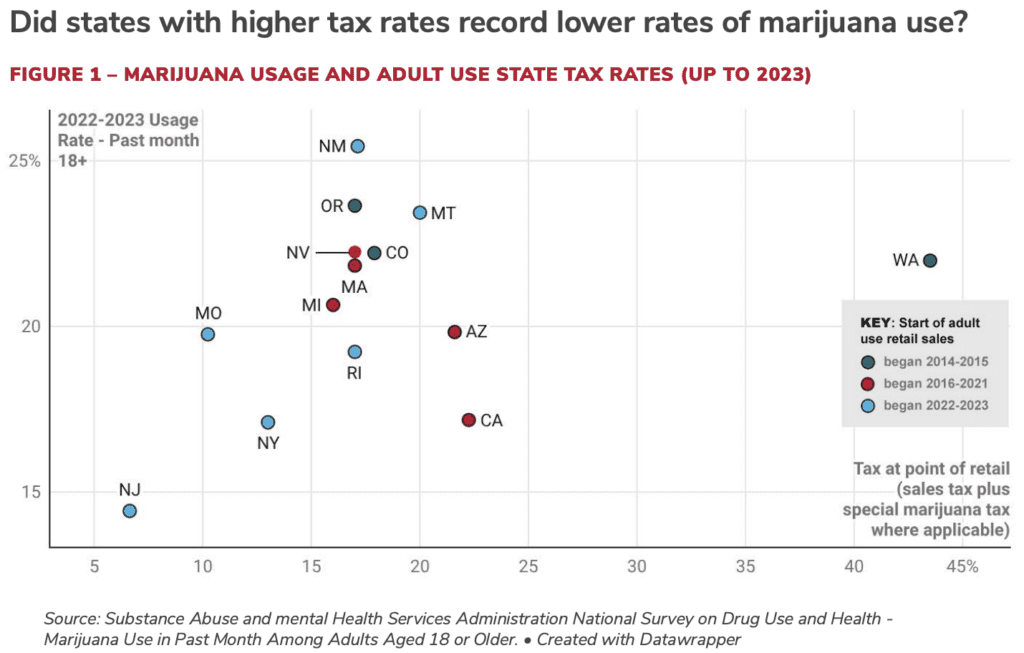
There’s no meaningful evidence that imposing higher taxes on marijuana would steer people away from using it—contrary to a claim recently made by the The New York Times editorial board—according to a new scientific analysis of cannabis consumption and tax data.
In fact, raising the cost of cannabis sold at state-licensed retailers could lead people to return to the illicit market to obtain cheaper (and untested) marijuana that carries its own public health and safety risks.
The new report, authored by Ohio State University (OSU) Moritz College of Law researchers Dexter Ridgway and Jana Hrdinová, drew on nationally representative survey data from federal sources and marijuana tax rates in states that have enacted legalization to test the idea that putting a higher premium on cannabis for adults could positively influence consumer behavior and deter heavy marijuana use.
In its editorial, the board emphasized that while the federal government imposes taxes on alcohol and tobacco sales, it doesn’t do the same for marijuana—which is no surprise given that the plant remains federally illegal, as do the state-licensed shops that sell it. The board said “increases in tobacco taxes have been a major reason that its use has declined during the 21st century, with profound health benefits.”
“The first step in a strategy to reduce marijuana abuse should be a federal tax on pot. States should also raise taxes on pot; today, state taxes can be as low as a few additional cents on a joint,” the editorial argued. “Taxes should be high enough to deter excessive use, on the scale of dollars per joint, not cents.”
The idea that high marijuana taxes are causally associated with lower usage rates isn’t exactly settled science, the OSU report said, as states with varying tax rates for cannabis have seen disparate trends in consumer behavior.
“More generally, at a time when the legal cannabis marketplace is a patchwork of ever-changing state laws and industries, the overall relationship between tax rates and marijuana use rates (and especially heavy use rates) is quite unclear,” the researchers wrote.
They pointed out, for example, that marijuana is taxed at the highest rate in Washington State (43.5 percent), and the state has the sixth highest usage rate (22 percent) in the dataset. By contrast, New Jersey has the lowest tax rate (6.6 percent) and reports the lowest usage rate (14.4 percent), ranking in the bottom half nationally.
“These patterns do not imply that taxes have no effect on consumption, but they do suggest that assuming marijuana users will respond to taxation like tobacco users is overly simplistic,” the report says.
Via OSU.
Ultimately, the OSU report—which assessed 2023-2024 survey data from the federal Substance Abuse and Mental Health Services Administration (SAMHSA)—concluded that “there is no apparent correlation between marijuana tax rate and marijuana usage rate.”
“Merely looking at tax rates and usage rates ignores the myriad of other factors that can influence the rate of use, such as the maturity of the legal market, the ease of access to product affected by number of dispensaries per population, the price of the product in a given state (since marijuana cannot be traded across state lines, the way states regulate the number of licensed growers significantly affects availability/price of product) and many other factors,” the researchers said.
“The New York Times editorial soundly stressed the importance, from a public health perspective, of limiting excessive or high potency marijuana use. Additional data is needed to assess the role of tax increases to deter the riskiest marijuana uses and users, and policy progress here will likely require a broader regulatory approach, besides taxation. These 2023 data suggest no simple inverse relationship between state tax rates and marijuana use, and effective policy must account for market structure, product availability and the wide availability of illicit product.”

Via OSU.
To be sure, where the editorial board, advocates and researchers seem to align is in their shared position that the federal government’s decades-long prohibitionist policies and the resulting lack of robust regulations is a problem. States have been passively permitted to participate in the cannabis experiment without federal safeguards in place or guidance on policy issues such as cannabis tax rates or potency limits for marijuana products, for example.
The marijuana tax policy discussion has continued to play out in states and cities across the U.S. where marijuana laws are being considered or tweaked. There might not be consensus around the appropriate tax rate for cannabis, but there’s a general understanding that governments must balance revenue interests with the need to make regulated cannabis products cost-competitive with the illicit market.
The Times editorial board further argued in its piece that an “advantage of taxes is that they fall much more on heavy users than casual smokers.”
“If a joint cost $10 instead of $5, it would mean a lot of extra money for someone now smoking multiple joints a day and may change that person’s behavior,” it said in the editorial, which has faced scrutiny from multiple skeptical sources. “It would not be a big burden for someone who smokes occasionally.”
But as the OSU analysis argues, there’s “reason to fear that significantly higher tax rates for marijuana products could shift use into unregulated and more dangerous illicit markets rather than to deter or reduce problematic cannabis use.”
At the federal level, marijuana may soon be moved from Schedule I to Schedule III of the Controlled Substances Act (CSA), which wouldn’t federally legalize the plant but would free up certain research barriers and allow state-licensed cannabis businesses to take federal tax deductions they’ve been barred from under Internal Revenue Service (IRS) code 280E.
That latter effect is expected to give the cannabis sector an economic boost, but because marijuana products would remain illegal to sell under federal law, rescheduling alone wouldn’t necessarily create a clear pathway for a new federal tax as the Times editorial board is proposing.
Removing the 280E penalty could also potentially bring cannabis prices down if industry operators decide to pass any of their tax savings on to the consumer.
“The federal government needs to be part of these solutions. Leaving taxes and regulations to the states threatens to create a race to the bottom in which people can cross state lines to buy their pot,” the board said. “Congress can set a floor, as it has done, however inadequately, with alcohol and tobacco, and states can build on it as they choose.”
Various congressional bills to legalize cannabis have included federal tax provisions, with specific appropriations in mind for the revenue, but none of those have advanced in the current Congress.
