


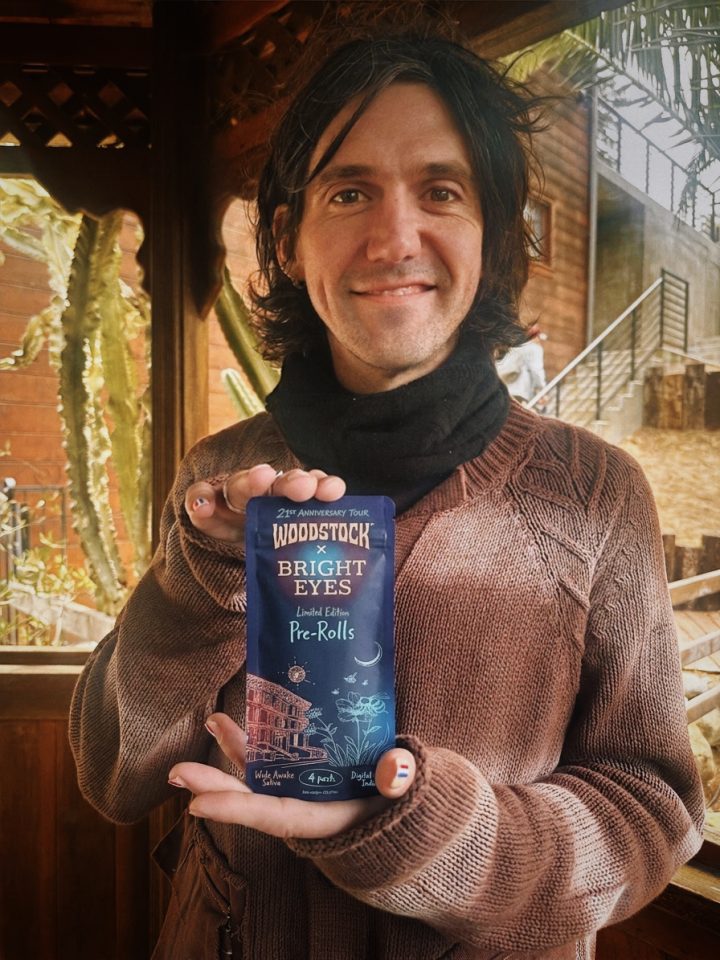
As Bright Eyes revisits its landmark albums with a Woodstock cannabis collaboration, Conor Oberst reflects on sobriety, survival, and staying human.
For a certain kind of person, I’m Wide Awake, It’s Morning was not just an album. It was survival literature.
It lived in burned CD binders, scratched iPods, shitty car stereos, headphones worn during long walks after bad nights, worse relationships, panic attacks, protests, hangovers, and moments where the future felt like a collapsing building you were somehow expected to live inside. Bright Eyes did not soundtrack the 2000s indie experience so much as emotionally document it in real time.
When Bright Eyes released I’m Wide Awake, It’s Morning and Digital Ash in a Digital Urn simultaneously in 2005, Conor Oberst became the reluctant voice of a generation that felt politically betrayed, emotionally overexposed, artistically restless, and permanently suspicious of American optimism. One album leaned folk, ragged, intimate, and politically furious. The other drifted through electronics, delay, experimentation, and alienation like a transmission from a nervous breakdown happening inside a laptop.
Twenty-one years later, Oberst is revisiting both records for a series of anniversary shows culminating June 6 at Forest Hills Stadium in Queens. Bright Eyes has also partnered with Woodstock on a limited-edition cannabis collaboration themed around the albums: a sativa tied to Wide Awake and an indica inspired by Digital Ash.
On paper, that combination could sound cynical. Legacy indie band meets weed branding in late capitalism. But talking to Oberst now, the collaboration lands differently because his relationship to cannabis — and to himself — has fundamentally changed.
This is not the same Conor Oberst who once romanticized collapse in public.
And honestly, that may be the most meaningful part of the story.
Revisiting the Albums That Changed Indie Music
Oberst sounds almost stunned by the passage of time when discussing the anniversary shows.
“It’s been a trip,” he says. “You don’t really think about it until you hit these little old milestones.”
The two albums were never meant to feel interchangeable. Even while writing them, Oberst realized they were pulling toward different emotional and sonic worlds. “I had been writing the songs kind of simultaneously, and then, as I was writing them, I realized they were diverging,” he says. “They weren’t going to all make sense together.”
I’m Wide Awake, It’s Morning became the more publicly mythologized record: acoustic guitars, New York imagery, heartbreak, war anxiety, and Oberst’s cracked-open writing style colliding into one of the defining indie albums of the 2000s. But Digital Ash in a Digital Urn was equally important to understanding Bright Eyes, even if it confused listeners expecting another folk confessional.
“I think a lot of people that just know Wide Awake think we were more of a folk or alternative country band,” Oberst says. “But we’ve always fucked around with keyboards and effects.” He pushes back against the idea that Digital Ash was simply an “electronic” album. “When I think of electronic, I just think of blips and bleeps and stuff like that,” he says. “To me, it definitely has more of a dark rock-and-roll thing.”
The records were also made completely differently.
“Wide Awake, we recorded in like two weeks,” Oberst says. “And we spent probably nine months making Digital Ash.”
Releasing them simultaneously was partly artistic instinct and partly youthful bravado.
“I think part of it was a little braggadocious,” he says. “‘Look what we can do’ kind of thing.”
At the time, the move felt audacious. In hindsight, it feels almost impossible now. The modern music industry barely allows artists enough oxygen to release one fully realized album without feeding it into the content machine for a year straight. But Bright Eyes emerged from a different ecosystem — one built around scenes, labels like Saddle Creek, live rooms, physical media, and communities that existed long before algorithms started flattening culture into metrics.
That world shaped Oberst just as much as the records themselves.

Finding the Freaks
Before Bright Eyes became synonymous with emotionally devastating indie music, Oberst was a kid growing up in Omaha, Nebraska, searching for people who made him feel less alone. “I grew up in Omaha, Nebraska, pretty conservative, like football-insurance-town,” he says. “But I found the freaks. I found the punk rockers. I found my people that were interested in art, and that’s how I survived.”
That sentence explains more about Bright Eyes than almost any genre label ever could. The band arrived during a period when young people were still physically searching for each other through basements, coffee shops, record stores, VFW halls, college radio stations, and tiny clubs. Long before TikTok niches and algorithmic identity curation, subculture required effort. You had to go find the weirdos in real life.
That communal energy still matters deeply to Oberst.
“There’s no replacing the IRL,” he says. “No clip from a fucking phone is going to give you the same feeling of seeing a sweet band play.”
Asked what advice he gives younger artists, he does not talk about branding strategy or social growth hacks.
“Get in the practice room,” he says. “Write a bunch of awesome songs. Learn how to play them tight and then just play wherever and whenever you can.” That perspective feels increasingly radical now. So much of modern music culture revolves around optimization, visibility, and performance metrics. Bright Eyes came from a world where the goal was simply to make something emotionally true enough to matter to another person.
And for a lot of fans, these records mattered immensely. Oberst still sounds humbled by the fact that people carried these songs with them into adulthood. “The music really is a part of people’s lives,” he says. “And that’s something I don’t take lightly at all.”
Cannabis, Sobriety, and Staying Present
Cannabis has always existed somewhere in Bright Eyes lore. Oberst laughs easily about how entwined weed once was with the creative process.
“I started smoking as a teenager,” he says. “Probably a good 10 years where it was very entwined with creativity. Smoke when we played, smoke when we recorded.”
But age changes chemistry. Somewhere in his late twenties and early thirties, cannabis stopped feeling comforting and started making him paranoid. Then his life changed again. About a year and a half ago, Oberst experienced health issues that pushed him to stop drinking and step away from harder substances entirely. Cannabis re-entered his life differently this time — not as romantic chaos fuel, but as maintenance, ritual, and recalibration.
“I lean a lot more on THC drinks and eating it and sometimes smoking it,” he says. “It’s just such a better, less destructive thing for my body.” He is careful not to turn his experience into universal advice. “It’s different for everybody,” he says. “I’m not here to say, ‘Do it my way.’ But for me, for what’s worked for me…”
What works now is moderation, functionality, and presence. Oberst speaks about THC drinks almost tenderly, not because of intoxication itself, but because of what they allow socially. “It’s just nice to have a drink in your hand when everyone’s partying,” he says. “And you’re still feeling good and having fun.”
Then comes the line that quietly reframes the entire conversation around cannabis culture and recovery. “I really hope someday there’s just weed drinks in all the bars,” he says. “I think it’d be a better situation for society.”
For artists of Oberst’s generation, that shift carries real emotional weight. Indie music in the 2000s often romanticized self-destruction so aggressively that surviving long enough to become stable almost felt culturally uncool. Oberst himself became partially mythologized through emotional volatility, booze-soaked performances, and the image of a young songwriter unraveling publicly in real time.
The older Oberst sounds less interested in destruction now. More interested in surviving it.


The Sweet Spot
One of the most revealing parts of the conversation comes when Oberst describes performing sober.
“When I first started playing again and not drinking and stuff,” he says, “I was like, ‘Oh my God.’ You’re paying attention to the guy in the front row doing something weird.”
Anyone who has ever seen Bright Eyes understands the strange intimacy of those shows. Oberst built an entire career on emotional exposure. The audience relationship was never casual. Fans did not simply listen to these records. They projected themselves into them. That level of connection can become psychologically overwhelming.
“You want to be there with them because it is a communal thing,” he says. “But it’s sort of nice to have some kind of fourth wall.”
Cannabis helps him maintain that balance now — connected without becoming consumed. “It’s all about finding the sweet spot,” he says. Enough space to keep singing the songs without disappearing into them.
Old Songs, New Wars
Revisiting these albums also means confronting how little some things have changed. One song hitting differently for Oberst now is “Old Soul Song (For the New World Order),” written after moving to New York during the buildup to the Iraq War.
“It’s kind of about going to a protest in New York City,” he says. More than two decades later, he hears the song against another backdrop of violence in the Middle East. “To think that 21 years later, we’re just enduring another war of choice in the Middle East — it’s sad to me,” he says.
The line lands because Bright Eyes was never purely personal music. Oberst’s writing always blurred the boundary between emotional collapse and political disillusionment. The records mattered because they captured what it felt like to come of age during an era where both private life and public life felt unstable at the same time.
That tension still exists. So does the exhaustion. But Oberst has not entirely lost faith in progress either. Cannabis legalization represents one of the few places where he sees the culture moving forward instead of backward.
“To see cannabis things moving in what I see as a more positive, progressive way,” he says, “I guess it’s a silver lining.”
Why the Woodstock Collaboration Works
That perspective is partly why the Woodstock collaboration makes sense. Not because it feels corporate. Because it feels generational. Woodstock, for all its mythology and commercialization over the decades, still symbolizes a certain strain of counterculture idealism: music, community, altered consciousness, political unrest, and collective escape colliding together.
Bright Eyes emerged from a later generation of counterculture — post-Nirvana, post-9/11, Iraq War-era indie alienation — but the connective tissue is still there.
Oberst admits he was surprised the partnership was even possible. “It was one of those things,” he says. “Like, it’s 2026, I didn’t even know that was really an option.” The collaboration itself mirrors the emotional duality of the albums: one sativa tied to Wide Awake, one indica tied to Digital Ash.
“That’s the perfect storm,” Oberst says. “Something we can get behind.”
More importantly, he sees cannabis culture evolving beyond caricature. “It’s nice to see the decriminalization of it,” he says, “and stopping demonizing it.”
He also acknowledges the contradictions inside legalization: big money, corporate influence, and smaller legacy operators getting squeezed out. But compared to criminalization and fear, he still sees legalization as progress.
“Maybe better to regulate the things people are going to do,” he says, “and try to present them in a safer situation.”
Still Wide Awake
Near the end of the conversation, Oberst shares what still drives him creatively after all these years.
His answer is deceptively simple. “It’s love,” he says. “Love for creativity, love for my friends and collaborators, love for the fans and people that support the art.”
Then he gets closer to the real answer. “As a songwriter, I’m kind of doing my best to document the human condition as I experience it,” he says. “And that’s a lifelong pursuit.”
That pursuit is what makes these anniversary shows feel bigger than nostalgia. Nobody needs Bright Eyes to recreate 2005. The world already has enough empty retro worship. What matters is seeing what survives after the chaos burns off: the songs, the community, the people who carried them forward, and the artist himself learning how to stay alive inside his own mythology.
Conor Oberst once became famous for sounding like a person unraveling in public. Now he sounds like someone trying to remain human long enough to keep creating. Maybe that’s the real full-circle moment. Bright Eyes are still wide awake. Just a little less interested in destroying themselves to prove it.
Images courtesy of Woodstock Cannabis.
